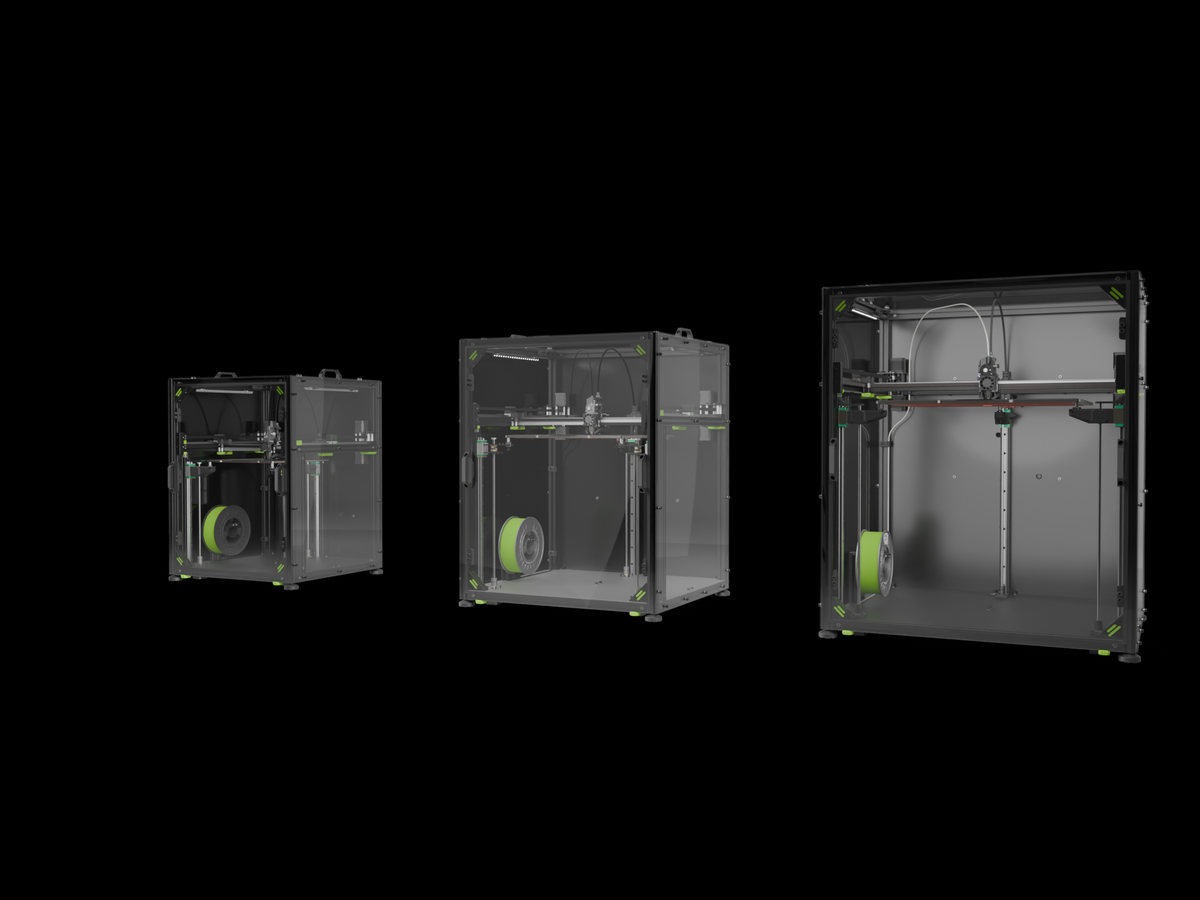
Of the three modes the V-Core 4.1 can run in, Hybrid is the easiest to overlook, it doesn't add a toolhead or change what you can print, it just makes the machine faster at printing it. That's worth unpacking, because the mechanism behind it is a genuinely clever piece of engineering, not just a bigger number on a spec sheet.

What actually changes
Standard V-Core 4.1 runs on regular CoreXY kinematics: one motor drives the X axis, one drives the Y axis, and the toolhead moves across two belts. The Hybrid upgrade adds two extra motors to the Y axis, turning it into Hybrid CoreXY. Nothing about the frame changes, there's no rebuild, you're adding motors and belts to the existing gantry.

Why more motors means more speed
Input shaping lets Klipper cancel out the ringing and vibration that comes from accelerating a toolhead quickly, but how hard you can push it is limited by how much the belts and frame flex under load. Splitting the Y axis across two additional motors, and tensioning the belts correctly, changes that limit: it lets RatOS recommend more than double the input shaper acceleration on the Y axis compared to standard CoreXY. In practice, that means noticeably faster prints on exactly the moves that used to be the bottleneck, without giving up surface quality. If you want to measure exactly how far you can push that on your own machine, see Getting the Most Out of RAT.
What you're trading for it
Hybrid doesn't unlock a new printing capability the way IDEX does, it's a straight performance upgrade for a single toolhead machine. The trade-off is build complexity: more motors to wire, more belts to tension correctly, and a bit more to get right during commissioning. For most people the right move is to build Standard first and add Hybrid once you know you want more speed, rather than treating it as a default.
Hybrid is also worth knowing about even if you don't plan to stop there, since it's a required step on the way to IDEX. We cover how all three modes fit together in The V-Core 4.1, Every Build Path Explained, and what the second toolhead on top of Hybrid actually buys you in IDEX Printing, Explained.
Your rig, your rules.